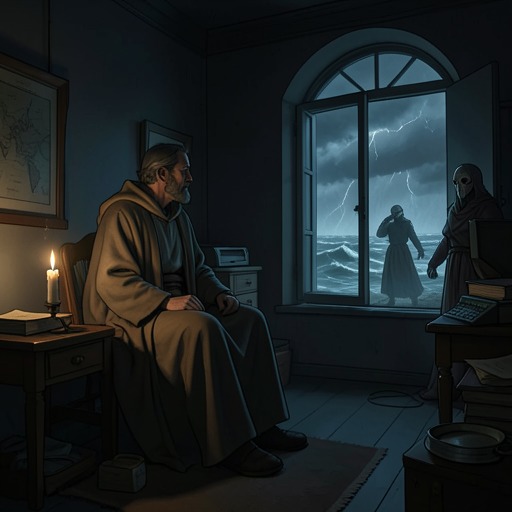
“The foreign god”
Death in Venice“The foreign god” is the veiled name Aschenbach recognizes in a dream of overwhelming collective frenzy. The phrase marks a decisive change in the novel’s mythic language: classical references that had helped him treat beauty as a route from the senses toward the spirit now accompany a vision of disorder that overwhelms his intellectual discipline and leaves him more completely under desire’s power.
From Beauty to Myth
Earlier, Aschenbach sees Tadzio’s beauty as more than a pleasing appearance. He imagines the boy’s form as a visible likeness of an ideal perfection, and reflects that the senses may help the mind approach what is spiritual. In this account, Amor uses the visible beauty of youth as a tangible aid to understanding what otherwise cannot be seen. Beauty is thus both an object of desire and a means of higher contemplation, though Aschenbach recognizes that it is a road rather than an end in itself.
His thoughts take the form of an imagined dialogue between Socrates and Phaedrus beneath a plane tree near Athens. Socrates describes the reverent disturbance caused by a beautiful body: the noble-minded tremble before it and honor its possessor, while the lover’s experience becomes more divine than the beloved’s because the god is present in the lover. This philosophical framing gives Aschenbach a language in which to dignify his attraction, while also exposing its asymmetry: the ideal he pursues is bound up with his own response.
Dawn and the Mythic Imagination
Aschenbach’s days in Venice become organized around Tadzio’s presence. He has stopped treating his stay as a fixed vacation, has sent for more money, and worries instead that the Polish family might leave. At dawn he waits at an open window for the sun, while the changing sky prompts visions of divine figures and a world made newly vivid. He recognizes that emotions suppressed by his disciplined life are returning in unfamiliar forms.
The mythic pattern continues when he watches Tadzio playing ball on the beach. The boy becomes Hyacinth in Aschenbach’s imagination, loved by two gods and fated to die through a rival’s jealousy. Aschenbach identifies himself with Zephyr’s jealousy and imagines the fatal blow and the flower that carries grief forward. The scene does not describe an actual death: it shows how myth turns his observation of the boy into a drama of desire, rivalry, and loss.
The Dream of the Foreign God
The phrase arrives in a dream after Aschenbach has learned of the danger in Venice and chosen to remain silent. He pictures the neglected, diseased city, yet the thought of its disorder awakens hopes that he regards as irrational. He stays in Venice, and that same night the dream begins with apprehension as an approaching tumult gathers force. Amid the confusion of the vision, he recognizes one veiled name: “The foreign god!”
The dream’s setting shifts to mountains resembling those around his summer house. A crowd of people and animals pours down through the woods in a whirling, disorderly procession. The vision builds through music, dance, and ritualized frenzy until Aschenbach’s resistance fails. He had considered himself committed to defending intellectual poise and dignity, but the dream draws him into the collective experience he had feared. Its force is not a calm philosophical argument: it is an assault on the self that had depended on culture and self-command.
Meaning and Aftermath
The foreign god gives a name to the dream’s opposing force: a Dionysian release that breaks through the Apollonian ideals of form, restraint, and individual control. The contrast sharpens the earlier account of beauty. Beauty had seemed capable of leading the senses upward toward spiritual understanding; now desire and myth carry Aschenbach toward a loss of boundaries, where his cultivated resistance is absorbed into the very disorder it opposed.
When he awakens, he is shaken and feels himself still under the dream’s power. He no longer takes the same care to avoid other people’s inquisitive looks, even as Venice empties and the truth about the danger appears to be spreading. Tadzio remains, and Aschenbach’s fixation continues: he watches him and follows him through streets where death is concealed. The dream does not create the city’s danger, nor does it resolve Aschenbach’s desire. Instead, it brings their convergence into focus: the vision of disorder accompanies his abandonment of restraint, while the city’s concealed crisis continues around him.